You can't spray under Part 101
The everyday drone rules say an operator "must not carry out aerial spraying, aerial topdressing or application of aerial vertebrate toxic agent". This applies even to small drones.[1][2]
New Zealand agricultural drone guide
Spraying with a drone in New Zealand involves aviation rules, chemical rules and council rules. Airex sets out the whole pathway in plain English, from your operator certificate to your agricultural rating, with every rule linked to its source.
The short answer
The everyday drone rules say an operator "must not carry out aerial spraying, aerial topdressing or application of aerial vertebrate toxic agent". This applies even to small drones.[1][2]
Agricultural drone work needs a Part 102 operator certificate. It's issued to an organisation, not a pilot, so you either hold your own or fly for an operator that has one approved for ag work.[3]
The CAA looks for a Part 102-standard pilot qualification from a Part 141 school, a Pilot Chemical Rating, a UA Agricultural Rating for each type of work you do, and an annual Operational Competency Assessment (OCA) to stay current.[3]
The pathway
If you're starting your own operation, the operator certificate takes the longest, so it comes first. Pick a step to see what's involved.
Spraying, spreading and toxic-bait drops can only be done under a Part 102 Unmanned Aircraft Operator Certificate (UAOC). The CAA issues it to an organisation or a sole trader, not to a pilot.[3] You either apply for your own, which means writing an exposition (your operating manual), or you fly for an operator whose certificate is already approved for agricultural work and get inducted onto it.[3][4]
Starting your own operation? Do this step first. It's expected to take 8 to 10 months from submission to grant.[5]
The CAA accepts a drone pilot qualification from a Part 141 certificated training organisation, trained to the Part 102 standard, as evidence that a pilot is appropriately trained.[3] On its own it doesn't let you fly outside Part 101: that permission belongs to the operator you're inducted under.[8]
DroneTrust's course is online theory, which most people finish over a few weeks, followed by a practical flight assessment.[5]
The CAA's guidance says pilots must hold a Pilot Chemical Rating before they apply agrichemicals. It's a theory qualification covering calibration, drift, nozzles, weather, NZS 8409, regulation, hazardous substances and first aid, and it's valid for five years.[3]
DroneTrust's course runs entirely online: ten modules and a final exam (80% pass mark), about 14 to 18 hours in total.[9] More on the chemical rating.
An OCA checks that you can fly your operator's larger agricultural drone safely and that you know the procedures in the exposition you fly under. After it you can practise with the ag drone, but you can't apply chemicals until you hold an Agricultural Rating.[5]
The CAA's guidance also requires an annual Agricultural OCA through a Part 141 organisation to stay current.[3]
The CAA's guidance says pilots must also hold a UA Agricultural Rating before they can lawfully dispense agrichemicals from a drone. It includes theory, a practical assessment, instructor-supervised flights and a flight test, and each discipline (spraying, topdressing, toxic baits) needs its own rating. Only Part 141 organisations the CAA has specifically approved can deliver it.[3]
DroneTrust runs it under Part 141 certificate TR104722: two days with an instructor, then supervised flights over time.[10]
The aircraft
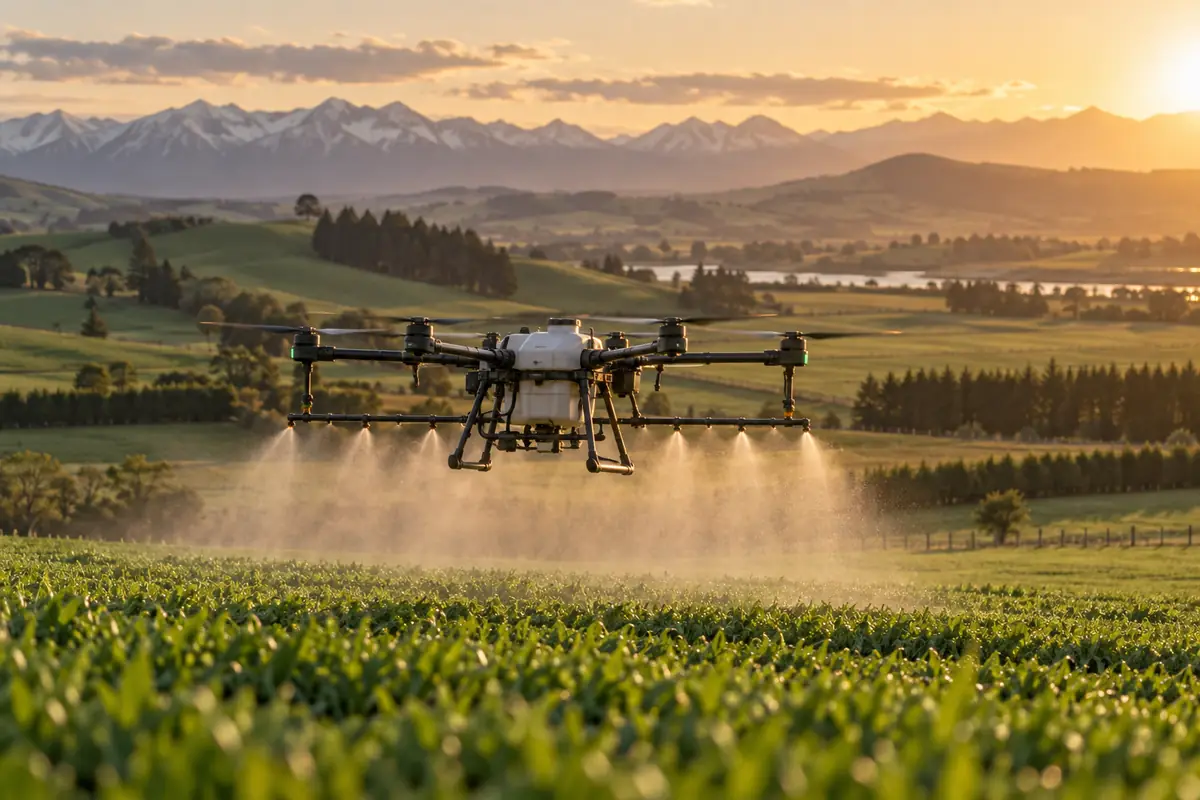
Today's spray drones are far heavier than the 25 kg ceiling for Part 101, even before you fill the tank:
That's why the operator certificate, the exposition and proper type training aren't optional extras. They're how the CAA makes sure a 100 kg aircraft full of chemical is flown safely.
Cost estimator
Built from DroneTrust's published course prices. Tell us where you're starting from.
Plus CAA certification charges: $312.40 an hour incl. GST, with 2 hours ($624.80) paid up front for a first Part 102 application. The final amount depends on how much inspector time your application takes.
Timing: expect 10 to 12 months end to end. Most of that is waiting for CAA certification, which is expected to take 8 to 10 months from submission, so apply early.
Timing: there's no certificate to wait for. Most people finish the Part 102 theory in a few weeks and the Chemical Rating in one to two weeks (14 to 18 hours), and the Agricultural Rating is two days with an instructor, then supervised flights over time.
DroneTrust's published prices in NZD, checked 28 September 2026. Examiner travel for the Agricultural Rating may be extra. Not included: your drone and equipment, insurance, and any resource consent. See the full cost breakdown.
Where to get expertise
Training, rules and approvals come from different places. Here's who to talk to for each.
Training provider Recommended
A CAA Part 141 certificated training organisation (TR104722). It offers every step of the ag pilot pathway, from the Part 102 Drone Pilot Certificate and the Pilot Chemical Rating to the OCA, the Agricultural Rating and exposition writing.[10][5]
View the DroneTrust pathwayDrones and equipment
New Zealand's largest commercial drone supplier. Ag drones, batteries, spare parts and ongoing support.
aerolab.co.nzIndustry body
The industry association for agricultural drone operators in New Zealand. Members get $1,500 + GST off DroneTrust's exposition writing service.
agdroneassociation.org.nzRunning a drone business
A franchise network for drone service operators, if you'd rather join an established brand than build your own.
droneboss.co.nzAviation regulator
Sets Parts 101 and 102, issues operator certificates, and publishes the agrichemical guidance for drones.[3]
aviation.govt.nz/dronesYour local rules
Sets the air-discharge rules for agrichemicals: drift, notification, buffers and consents. Growsafe keeps an index of each region's rules.[13]
How council rules workGround crew and chemical skills
Doesn't issue aerial certificates to individuals, but recommends its Standard certificate for ground crew. That certificate meets the "qualified loader" requirement.[14]
growsafe.co.nzHazardous substances
The EPA sets hazardous-property controls for agrichemicals. WorkSafe covers your workplace duties: safety data sheets, inventory and training.[15][16]
What applies to youAirspace
The CAA's advisory circular calls AirShare the preferred way to request access to controlled airspace.[2]
airshare.co.nzCommon questions
Not necessarily. You can fly for an organisation whose Part 102 operator certificate is approved for agricultural operations, once you've been formally inducted under its exposition.[3]
DroneTrust, our recommended provider, can take you from your first pilot certificate to a fully rated agricultural pilot, or pick you up partway through.
Checked on 28 September 2026. Rules change, so confirm anything important with the agency concerned. This guide is general information, not legal advice.